Currently Empty: £ 0.00

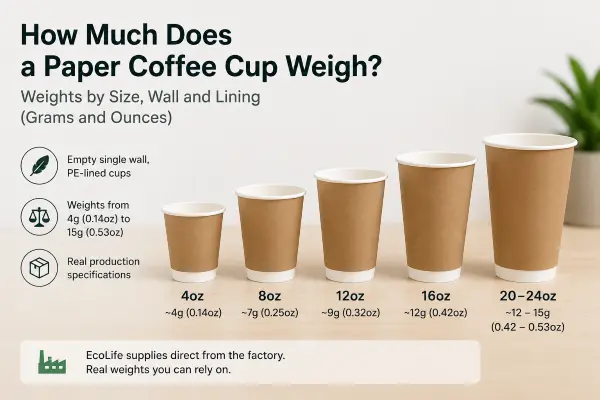
A paper coffee cup is a disposable, board-based drinking vessel, and an empty single wall cup weighs from about 4g (0.14oz) at the 4oz espresso size to roughly 12g (0.42oz) at 16oz. Larger 20oz to 24oz cups reach 12g to 15g. That range sits on an empty, single wall, PE-lined basis, before any lid, drink, or second wall adds mass.
Cup weight decides what you pay to ship, how many cups fit in a kilogram, and where board cost lands per unit. EcoLife supply these cups direct from the factory, so the numbers below come from real production specifications. This guide sets out the weight of every common size, then explains the four other factors that move the final figure. The exact weight depends on the cup’s size, so the size-by-size breakdown opens the guide.
How Much Does a Paper Coffee Cup Weigh?
An empty paper coffee cup weighs about 4g at 4oz, 7g to 8g at 8oz, 8g to 10g at 12oz, 10g to 12g at 16oz, and 12g to 15g across the 20oz to 24oz sizes. The table below lists each standard size on a single wall, PE-lined, empty basis. A single cup weighs a fraction of an ounce, so in pounds even a 16oz cup sits near 0.02lb, and pounds turn useful only once cups stack into cartons and pallets.
| Cup Size | Capacity (ml) | Empty Weight (g) | Empty Weight (oz) |
| 4oz | 118 | about 4 | 0.14 |
| 8oz | 227 | 7 to 8 | 0.25 to 0.28 |
| 12oz | 355 | 8 to 10 | 0.28 to 0.35 |
| 16oz | 473 | 10 to 12 | 0.35 to 0.42 |
| 20oz | 591 | 12 to 14 | 0.42 to 0.49 |
| 24oz | 710 | 13 to 15 | 0.46 to 0.53 |
4oz Espresso and Cone Cup Weight
A 4oz paper cup weighs about 4g (0.14oz) empty. It holds 118ml on light board of roughly 135 GSM to 180 GSM. Cafes reach for this size for espresso, tasting shots, and water-cone dispensers, where a thin wall suits the small volume. Step up one size and the weight rises with capacity.
8oz Coffee Cup Weight
An 8oz paper cup weighs about 7g to 8g (0.25oz to 0.28oz) empty. It holds 227ml on board around 210 GSM to 260 GSM. This is the most-stocked cafe size for a flat white or cappuccino, which keeps it in near-constant demand. The most common takeaway size is a step heavier again.
12oz Coffee Cup Weight
A 12oz paper cup weighs about 8g to 10g (0.28oz to 0.35oz) empty. Manufacturer specifications place a 12oz single wall cup at 7g to 9g on board of 253 GSM to 310 GSM, holding 355ml, which makes this the best-evidenced figure in the range. For the full set of size dimensions, the paper cup sizes guide maps every option against its use. Larger servings need more board, as the 16oz shows.
16oz Coffee Cup Weight
A 16oz paper cup weighs about 10g to 12g (0.35oz to 0.42oz) empty. It holds 473ml on board of roughly 260 GSM to 300 GSM. This large size covers iced drinks and long blacks, where the extra capacity carries a matching lift in board mass. The largest cold sizes are heavier still.
20oz to 24oz Cup Weight
A 20oz to 24oz paper cup weighs about 12g to 15g (0.42oz to 0.53oz) empty. Capacity runs from 591ml to 710ml on thicker board of 300 GSM to 340 GSM. These oversized cold cups hold more ice and liquid, so the heavier board resists sagging under the load. Size sets the baseline, but four other factors move the final weight.
What Determines a Paper Cup’s Weight?
A paper cup’s weight comes mainly from how much board it uses and how heavy that board is. Five factors set the final figure: capacity and surface area, board weight in GSM, wall construction, the waterproof lining, and small structural details at the rim, base, and print. Each adds a measurable amount, ranked below by effect. The largest of them is the most intuitive, capacity.
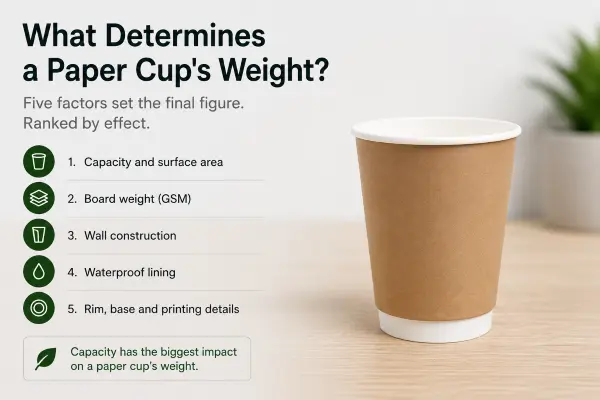
Capacity and Surface Area
Capacity sets weight because a bigger volume needs more board to wrap it. Doubling a cup’s capacity raises its board surface area by about 40% to 60%, which adds several grams to the empty weight. A 4oz cup and a 24oz cup share the same shape, yet the larger one uses far more square centimetres of board. Area sets how much board is used, and GSM sets how heavy that board is.
Board Weight (GSM)
GSM, or grams per square metre, measures the mass of one square metre of paperboard. It is the single strongest lever on cup weight, because weight equals board area multiplied by GSM. Cupstock falls into three bands: light board at 135 GSM to 200 GSM, medium board at 210 GSM to 280 GSM, and high board at 280 GSM to 340 GSM.
Grammage follows ISO 536, the international paper standard, and the method for how to measure GSM for paper cups sets out the sampling and weighing steps. A second wall multiplies that board, so construction matters next.
Wall Construction
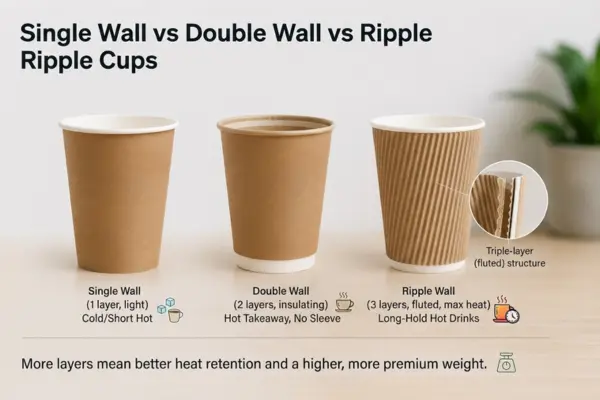
A second wall nearly doubles the board a cup uses. A single wall cup has one layer; a double wall cup bonds two layers at a combined 250 GSM to 350 GSM; a ripple cup adds a fluted middle layer for three layers totalling 600 GSM to 750 GSM. Each added layer lifts both insulation and empty weight in step. A thin inner film adds the final fraction, the lining.
Waterproof Lining (PE, PLA, Water-Based)
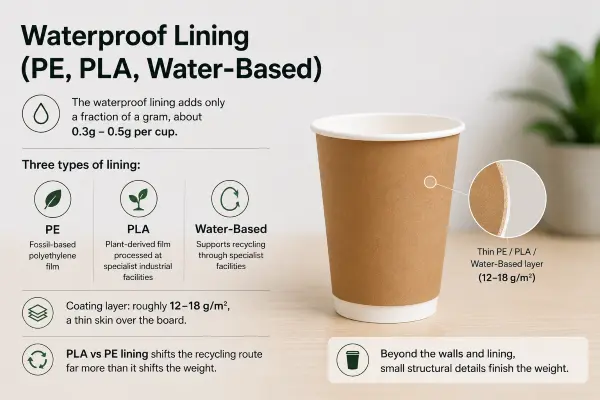
The waterproof lining adds only a fraction of a gram, about 0.3g to 0.5g per cup. Cups carry one of three linings: PE, a fossil-based polyethylene film; PLA, a plant-derived film processed at specialist industrial facilities; or a water-based coating that supports recycling through specialist facilities.
The coating layer measures roughly 12 g/m² to 18 g/m², a thin skin over the board. The choice between PLA vs PE lining shifts the recycling route far more than it shifts the weight. Beyond the walls and lining, small structural details finish the weight.
Rim, Base and Print
The rolled rim, base disc, and print ink add small but real mass. Together the rim and base account for about 5% to 8% of the board mass, since both fold or stack extra board. A full-wrap print adds a marginal amount of ink weight. With the factors known, GSM turns into an actual weight.
How GSM Translates Into Cup Weight
Cup weight equals board area multiplied by GSM, plus the lining. A 12oz cup uses about 0.032m² of board, so at 280 GSM the wall blank works out at 0.032 × 280 = 9g, the flat sheet before forming. Trimming, the rolled rim, the base disc, and the lining then set the finished weight near 9g to 10g.
The same sum explains the whole range. Light 4oz cups use little area and low GSM, landing near 4g, while 24oz cups combine large area with 340 GSM board to reach 15g. The maths also shows why a heavier feel is not always a better cup, since GSM buys durability only up to the point the drink needs. The same maths explains why single, double, and ripple cups differ so much.
| Cup Size | Board Area (m²) | GSM | Wall Blank (g) |
| 8oz | 0.024 | 235 | about 5.6 |
| 12oz | 0.032 | 280 | about 9.0 |
| 16oz | 0.040 | 285 | about 11.4 |
Single Wall vs Double Wall vs Ripple Cup Weight
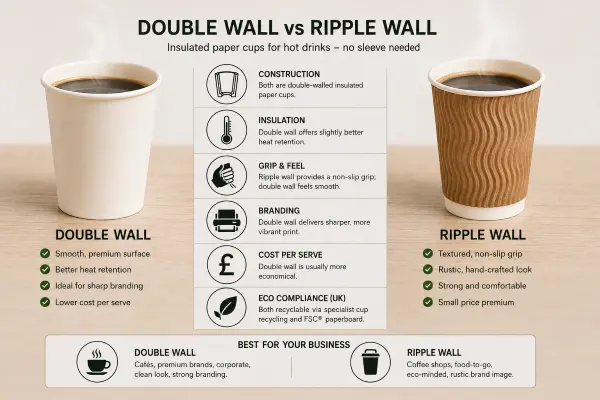
A double wall cup weighs roughly 1.6 to 2 times its single wall equivalent, and a ripple cup sits highest of the three. Adding a second layer of board drives the difference, since insulation and weight climb together. The table compares a 12oz cup across the three constructions.
| Construction | Layers | Typical GSM | Empty Weight (12oz) | Best For |
| Single wall | 1 | 253 to 310 | 8 to 10g | Cold drinks, short hot serves |
| Double wall | 2 | 250 to 350 | 14 to 16g | Hot takeaway, no sleeve |
| Ripple | 3 (fluted) | 600 to 750 | 17 to 20g | Long-hold hot drinks |
A single wall cup suits cold drinks and short hot serves, while a double wall cup holds heat for takeaway without a separate sleeve. The comparison of single wall vs double wall cups covers the insulation trade-off in full, and ripple wall vs double wall weighs the fluted option against it. Weight does not stop at the cup, since the lid adds to it.
How Much Weight Does a Lid Add?
A plastic sip lid adds about 2g to 4g, and a moulded-fibre lid adds about 4g to 5g. Lid weight tracks the material and profile, listed below for a standard 80mm rim.
| Lid Type | Material | Weight |
| Flat lid | PS | about 2g (0.07oz) |
| Sip lid | PP | about 3g (0.11oz) |
| Dome lid | PET | about 4g (0.14oz) |
| Moulded-fibre lid | Fibre | 4 to 5g (0.14 to 0.18oz) |
A 12oz cup and lid together reach about 11g to 14g, depending on the lid chosen. Knowing the per-unit weight lets you work back to bulk quantities.
How Many Paper Cups Are in One Kilogram?
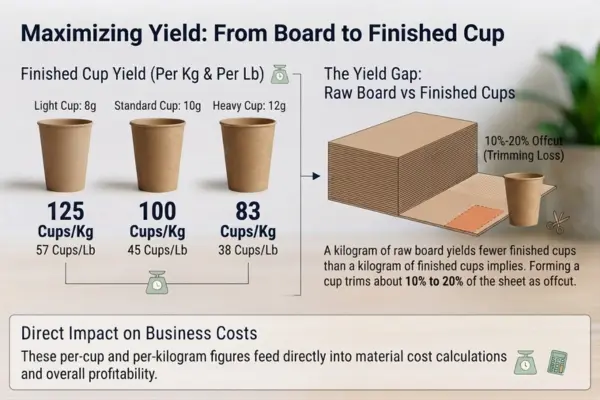
At about 8g each, one kilogram of finished cups holds roughly 125 cups. The count changes with per-cup weight: 8g gives 125 cups per kg, 10g gives 100, and 12g gives about 83. In pound terms, that is near 57, 45, and 38 cups per pound in the same order.
Raw board runs lower, because forming a cup trims about 10% to 20% of the sheet as offcut. A kilogram of board yields fewer finished cups than a kilogram of finished cups implies. These per-cup and per-kilogram figures feed straight into business costs.
Why Paper Cup Weight Matters for Your Business
Every extra gram multiplies across thousands of cups into freight cost and board cost. A single cup’s weight looks trivial, yet a busy cafe ordering 20,000 cups a month feels the difference in both delivery charges and unit price. Two areas carry the effect: shipping and carton weight, and cost per cup. It starts with how those grams stack up in a carton.
Shipping and Carton Weight
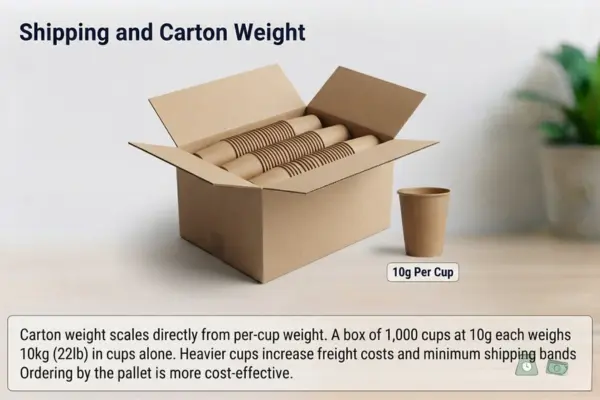
Carton weight scales directly from per-cup weight. A box of 1,000 cups at 10g each weighs 10kg (22lb) in cups alone, before the carton and packaging add their share. Couriers price by weight band and volume, so a heavier cup pushes an order into a dearer band or a larger pallet. Ordering wholesale paper cups by the pallet spreads that freight across more units and lowers the delivered cost per cup. Weight also drives the unit price of the cup itself.
Cost per Cup and Board Usage
Board is the largest single input in a paper cup’s cost, so board weight and unit price move together. Shifting the board grade by about 40 GSM changes the material used per cup, which shows up in the price of every unit. A lighter board trims the unit cost, while a heavier board buys durability the drink may need. The full breakdown of cost per paper cup sets these inputs against volume and print. Paper’s weight looks different once set beside plastic.
Paper Cup Weight vs Plastic Cup Weight
A 12oz paper cup at about 9g is lighter than a rigid PET plastic cup of the same capacity, which runs 12g to 18g. Paper board forms a thin single wall, while rigid plastic needs more material to hold its shape unsupported.
| Material | 12oz Empty Weight | Notes |
| Paper (single wall) | 8 to 10g (0.28 to 0.35oz) | Board with a thin lining |
| Material12oz Empty WeightNotesPaper (single wall) | 12 to 18g (0.42 to 0.63oz) | Solid moulded wall |
Rigid plastic cups also fall under the UK Plastic Packaging Tax when recycled content sits below 30%, charged at £228.82 per tonne from 1 April 2026, a cost paper board avoids. The weight and tax picture for plastic cups vs paper cups sets out the full comparison. If you want to confirm any of these figures, weighing a cup takes seconds.
How to Weigh a Paper Cup Accurately
Weigh a stack of ten cups, then divide by ten, for a reliable per-cup figure. A single cup weighs so little that scale error and static distort the reading, which the stack-and-divide method smooths out.
- Zero a digital scale that reads to 0.1g.
- Weigh ten cups of one size together.
- Divide the total by ten for the per-cup weight.
- Repeat for each size and construction you stock.
With the numbers in hand, the practical question is which weight to order.
How Do These Weights Guide the Cups You Order?
Cup weight reflects three things: size, wall construction, and lining. Those same three choices decide which cup fits your drinks and your delivery costs. A few common questions about paper cup weight come next.
Frequently Asked Questions About Paper Cup Weight
These questions cover the points buyers raise most often about paper cup weight.
Is a Heavier Paper Cup Always Better Quality?
No. The right GSM for the drink matters more than raw grams. A 12oz hot cup needs board around 280 GSM to hold heat and shape, yet going heavier adds cost without a matching gain. Quality rests on the board grade, lining, and forming, not weight alone. Weight also raises a recycling question.
Does the Plastic Lining Make the Cup Non-Recyclable?
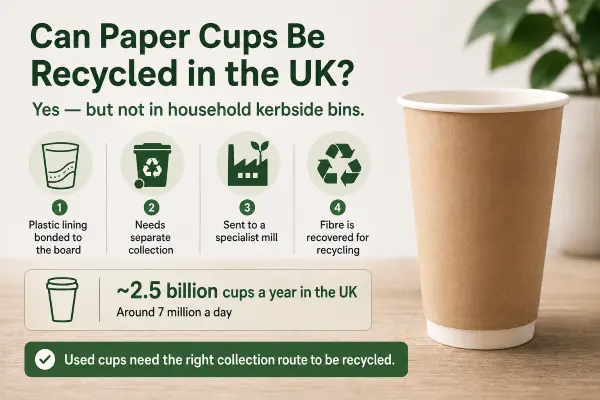
Not automatically. A PE-lined paper cup is recyclable through specialist facilities that separate the board from the film, rather than through standard kerbside collection. Whether a cup reaches those facilities depends on local provision. The detail on whether are paper cups recyclable explains the routes available. On weight, the lightest size is a common query.
What Is the Lightest Paper Cup Size?
The 4oz espresso and cone cup is the lightest, at about 4g (0.14oz) empty. Its small 118ml capacity and light board of 135 GSM to 180 GSM keep the mass low. It suits espresso, tastings, and water dispensers where volume stays small. A related comparison is whether double wall cups double the weight.
Do Double Wall Cups Weigh Twice as Much?
Nearly, but not exactly. A double wall cup weighs about 1.6 to 2 times its single wall equivalent, so a 12oz single wall cup near 9g becomes about 14g to 16g as a double wall. The second board layer, not a full doubling, drives the rise. These answers lead back to choosing the right cup weight.
Choosing the Right Cup Weight for Your Drinks
Match cup weight to the drink: light single wall board for cold drinks, and heavier double wall or ripple board for hot takeaway. The drink sets the wall and GSM, which in turn set the weight you ship and pay for.
| Drink | Suggested Cup | Empty Weight (12oz) |
| Cold drinks, water | Single wall, 250 to 300 GSM | 8 to 10g |
| Hot coffee, takeaway | Double wall, 300 to 340 GSM combined | 14 to 16g |
| Long-hold hot drinks | Ripple, 600 to 750 GSM combined | 17 to 20g |
Matching which cup size for which drink to the serving keeps both heat retention and delivery cost in balance. Order a sample pack to weigh the options against your own drinks before you commit to a bulk run.